
The “Good Food Every Day – Sustainable Food Education for Schools” project offers schools an expert for a day to promote students’ school meal consumption and their participation in planning school meals. In this blog post, Master’s student in human nutrition and food related behaviour Neha Imran reflects on her participation in an elementary school visit, where she was involved in organizing interactive activities for pupils alongside the project’s expert.
Context
The session was designed following principles like the Sapere method, which emphasizes learning about food through sensory engagement rather than prescriptive instruction. Students participated in a series of activities involving smell, taste, sight and interactive games, alongside discussions about school meals and cross-cultural comparisons.
While the structure of the session aligned with contemporary approaches to experiential learning, the students’ responses and behaviours revealed important gaps between intended learning outcomes and actual behavioural tendencies.
Familiarity as a Primary Determinant of Choice
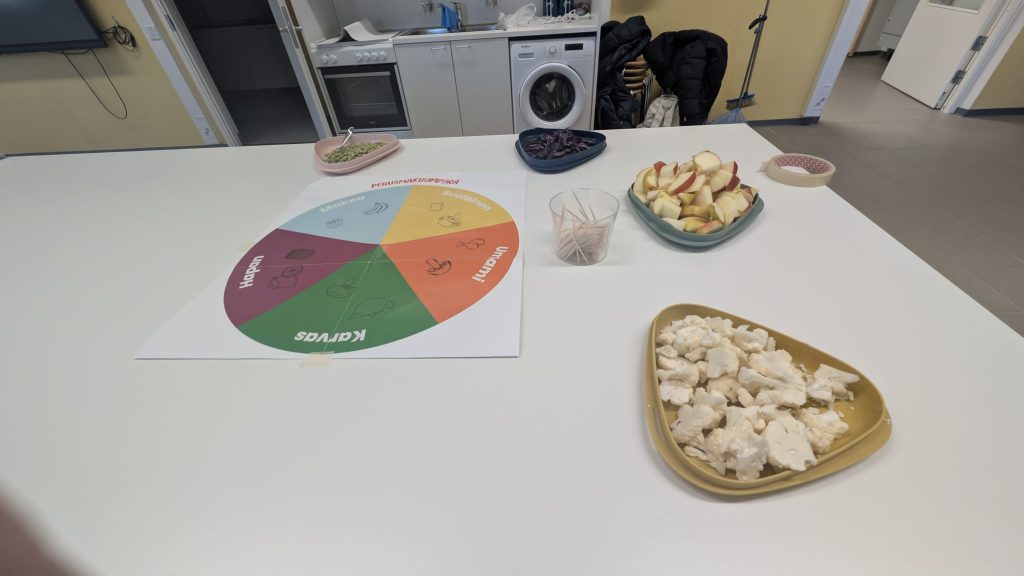
One of the most consistent patterns I observed during the tasting activity was the preference for familiar foods. When presented with options such as apple, roasted beans, cabbage, and cauliflower, many students selected the apple first.
When I asked them to explain their choices, students say: they knew how the apple would taste. In contrast, vegetables such as cabbage and cauliflower were often rejected based on their visual appearance. This suggests that as seen earlier familiarity reduces uncertainty, making it a dominant factor in decision-making.
Peer Influence and Collective Behaviour
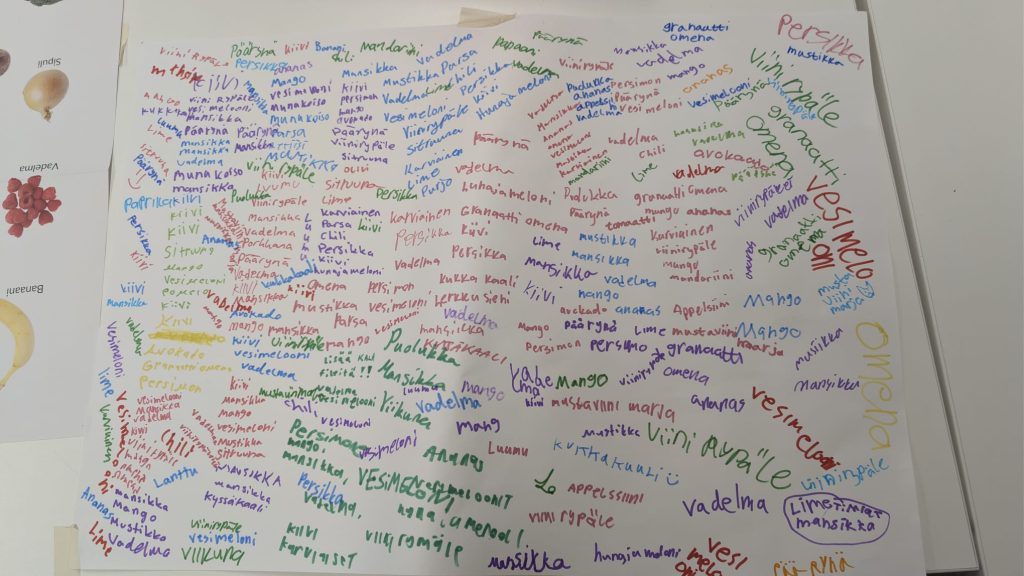
Another important observation was the strong role of peer influence. During the smell identification activity, students frequently converged on a single answer, often repeating the response of one peer rather than relying on their own sensory perception. Similarly, in the poster activity, repeated entries such as watermelon, mango, and strawberry appeared across different sections of the sheet. The clustering and duplication of responses suggest that students particularly those participating later were influenced by what had already been written, often discussing existing answers before deciding their own.
The Limits of Abstract Nutritional Knowledge
The session also included a true-or-false activity focused on the benefits of dietary fibre. Despite the scientific relevance of the topic, student engagement was notably low. Many participants struggled to connect the information to their daily experiences, and discussions remained limited. This may be partly explained by the fact that the topic was new to the students and had not yet been covered in their lessons.
In contrast, highly interactive activities such as a game involving hidden food cards generated significantly higher levels of enthusiasm and participation. This contrast highlights a limitation of traditional nutrition education. This contrast suggests that, while traditional nutrition education remains important, it may benefit from being complemented with more interactive approaches.
Implications for Food Education
Taken together, these observations challenge the effectiveness of information-centered approaches to food education. While knowledge remains important, it does not automatically translate into behaviour.
Instead, children’s eating habits appear to be driven by:
- Familiarity and repeated exposure
- Sensory experiences and immediate perceptions
- Peer influence and social norms
From Knowledge to Habit Formation
A more effective approach is integrating healthy eating into children’s habitual and unconscious decision-making processes. This involves creating environments where healthy options are not only available, but also familiar, appealing, and socially reinforced.
In this sense, the goal of food education is not simply to inform, but to normalize.
Ultimately, the question is not whether children understand what is healthy, but whether choosing healthy feels natural to them.
Conclusion
The findings from this school visit highlight a fundamental disconnect between what children are taught about food and how they make choices. Bridging this gap requires a broader understanding of behaviour – one that acknowledges the roles of familiarity, social context, and lived experience. Ultimately, the question is not whether children understand what is healthy, but whether choosing healthy feels natural to them. Only when healthy eating becomes part of their everyday unreflective behaviour can meaningful and lasting change be achieved.
Neha Imran
master student of human nutrition and food related behavior
University of Helsinki
7.5.2026